Surging Diesel Prices Could Accelerate Payback for RNG-Powered Trucks
Staff
Published September 17, 2026
Higher diesel prices are changing the economics of fleet replacement, with a new Energy Vision analysis estimating that fleets could recover the additional upfront cost of a renewable natural gas (RNG)-powered Class 8 tractor in roughly 1.3 to 2.8 years, depending on annual mileage and the fuel-price difference between diesel and natural gas.
The sharp increase in diesel prices is making alternative-fuel trucks more financially interesting for some trucking operations, particularly fleets looking to replace aging Class 7 and Class 8 equipment.
That is the central finding of an updated report from the nonprofit Energy Vision, which evaluates several alternatives to older diesel-powered trucks.
The national average price for on-highway diesel reached $6.285 per gallon on Sept. 14, approximately 65% above the $3.81 level reported shortly before the Iran war began in February. California's average was even higher, at $8.039 per gallon, based on the latest data from the U.S. Energy Information Administration.
Energy Vision's updated study, “A Path to a Healthier America: Ditching Old Diesel Trucks,” examines three potential replacements for aging diesel equipment:
New diesel trucks operating on renewable diesel
Battery-electric trucks
Natural gas trucks powered by renewable natural gas
The original analysis was released in March 2025. Energy Vision has now revisited its calculations after a major shift in fuel prices changed the financial comparison among the technologies.
According to the report, renewable diesel typically remains priced relatively close to conventional petroleum diesel, meaning its cost has also increased as diesel prices have climbed. Natural gas, by comparison, has experienced less direct impact from recent disruptions affecting global oil supplies.
By early September, Energy Vision estimated that compressed natural gas (CNG) was approximately $2 per diesel gallon equivalent (DGE) cheaper than diesel nationwide. In California, the difference was estimated at roughly $3.50 per DGE.
Renewable natural gas has also become a major component of vehicle natural-gas consumption. Data from natural-gas industry group The Transport Project indicates that RNG represented 94% of natural gas used as vehicle fuel in 2025.
How Quickly Could an RNG Truck Recover Its Higher Cost?
The biggest financial question for fleets considering alternative fuel equipment is simple: How long will it take to recover the additional purchase price?
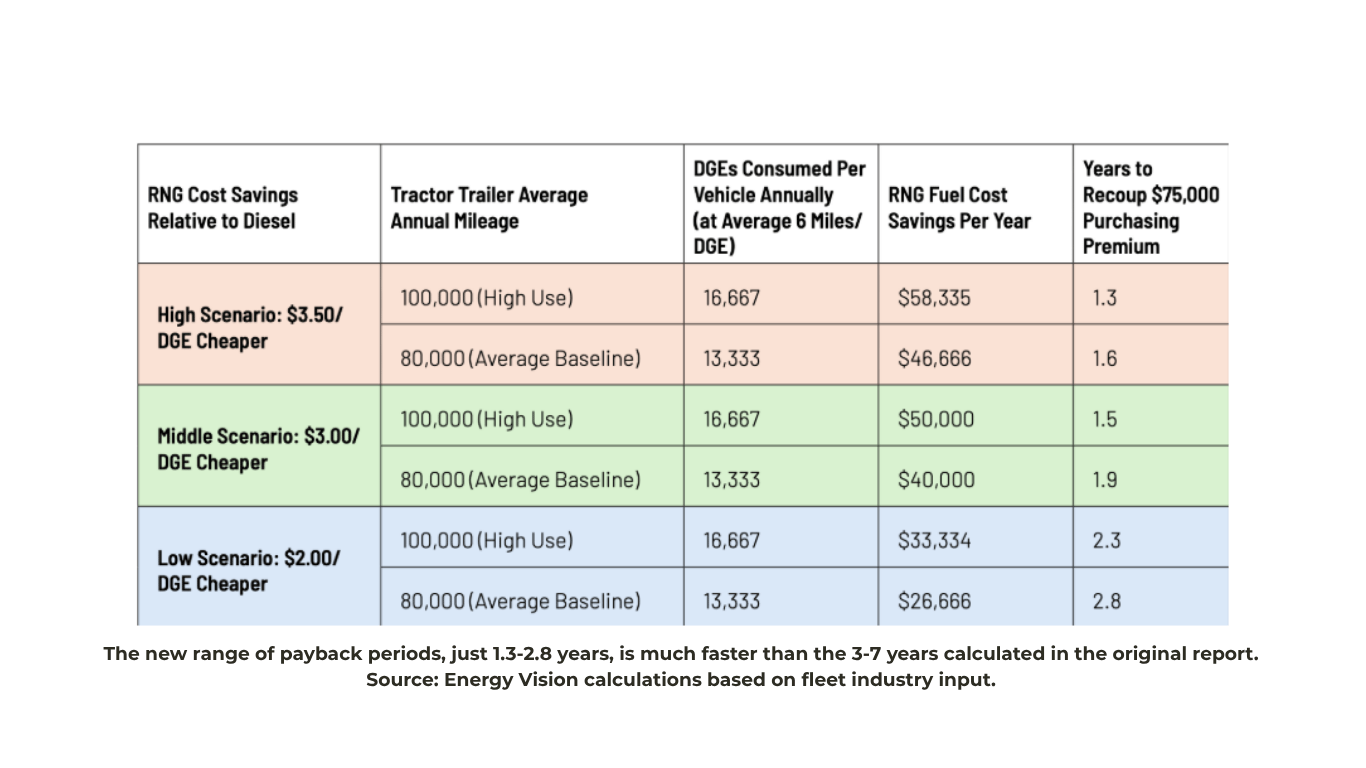
Energy Vision estimates that a new Class 8 natural gas tractor equipped with an engine such as the Cummins X15N carries an upfront premium of approximately $75,000 compared with a similar diesel truck.
However, lower fuel costs could allow a fleet to recover that additional investment considerably faster than it might expect.
For a tractor traveling 100,000 miles annually and achieving an average fuel economy of six miles per DGE, Energy Vision projects a payback period of approximately 1.3 years when RNG is $3.50 cheaper per DGE than diesel.
If the fuel-price advantage falls to $2 per DGE, the estimated payback period increases to approximately 2.3 years.
Stay Informed
Get freight market insights delivered to your inbox
Join industry professionals receiving our weekly analysis.
For trucks traveling around 80,000 miles annually, the projected payback ranges from approximately 1.6 to 2.8 years, depending on the fuel-price difference.
It is important to understand what these figures do and do not represent. The calculations are based primarily on fuel savings and are not a complete total-cost-of-ownership analysis. They assume the diesel-to-RNG price gap remains in place and do not include potential differences in financing, maintenance, fueling infrastructure, vehicle residual value or other operating costs.
“The economics of heavy-duty trucking have changed significantly in the past year and shifted the cost-benefit calculation for replacing diesel with clean alternatives,” said Michael Lerner, Energy Vision's director of research and publications and lead author of the report.
Lerner said the growing price difference between diesel and natural gas has strengthened the financial case for RNG, describing it in the report as the “most cost-effective, feasible, commercially available” option evaluated for large-scale diesel truck replacement.
Truck Supply and Fueling Infrastructure Still Matter
A favorable payback calculation does not necessarily mean a fleet can immediately make the switch. Truck availability could remain one of the biggest limitations.
Energy Vision reported that slightly more than 1,000 trucks equipped with the Cummins X15N were operating as of July 2026. At current production levels, manufacturers would not be able to supply the approximately 65,000 tractors included in the report's replacement scenario.
The report did, however, point to a Cummins projection that annual X15N sales could eventually reach 20,000 to 25,000 trucks by around 2030.
The availability of suitable fueling infrastructure is another critical factor.
Energy Vision counted approximately 1,400 CNG fueling stations nationwide as of August 2026, including 767 locations offering RNG. That represents significant growth from the 527 stations offering RNG in January 2025.
Still, the number of stations alone does not tell the entire story. For a trucking fleet, location and route compatibility are crucial. A fueling network may appear extensive nationally but provide limited value if a fleet's regular lanes do not pass near those locations.
Fleets considering RNG-powered equipment may also need to evaluate the potential expense of building or upgrading private fueling infrastructure, particularly for operations with centralized terminals.
How RNG Compares With Renewable Diesel and Electric Trucks
Among the three alternatives examined, renewable diesel has the lowest upfront barrier because it can be used in conventional diesel engines without requiring fleets to purchase an entirely different powertrain.
Energy Vision nevertheless estimated that renewable diesel would provide fewer public-health benefits than either RNG or battery-electric trucks.
Battery-electric trucks offer the advantage of zero tailpipe emissions, but the report identified several obstacles to broader deployment. These include higher vehicle purchase prices, charging-infrastructure expenses, utility interconnection challenges and limited availability of suitable models.
Using data from Calstart, Energy Vision reported that approximately 2,895 heavy-duty electric trucks, including 386 refuse trucks, had been deployed in the United States as of December 2025.
That figure remains small compared with the estimated 5.2 million Class 7 and Class 8 trucks operating across the country, illustrating the scale of the challenge involved in transitioning the heavy-duty fleet.
The Energy Vision analysis concentrated on approximately 130,000 pre-2013 heavy-duty diesel trucks operating across 31 highly populated counties.
According to the organization's estimates, replacing those older trucks with RNG-powered models could prevent between 1,560 and 2,205 premature deaths over a 15-year period.
Those health-impact estimates were developed using the Environmental Protection Agency's Co-Benefits Risk Assessment model, combined with emissions calculations developed by Energy Vision.
The organization also estimated approximately $30.3 billion in cumulative avoided healthcare costs over the projected 15-year operating lives of the replacement trucks.
Energy Vision is a national environmental nonprofit focused on reducing methane emissions and using captured methane as a resource for decarbonizing transportation and other sectors that can be difficult to transition away from conventional fuels.
For trucking fleets, the latest analysis highlights a broader industry reality: fuel prices can quickly change the financial equation behind equipment decisions. As diesel costs remain elevated, alternative powertrains such as RNG are receiving renewed attention not only for their emissions profile, but also for their potential to reduce operating costs and shorten the return on a fleet's equipment investment.