California Moves to Put Electric-Truck Prices Under the Microscope
Staff
Published September 22, 2026
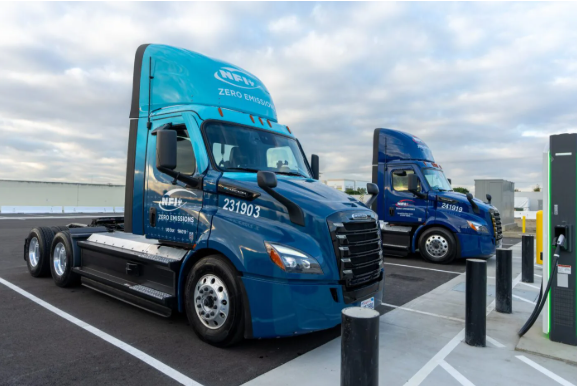

Why do battery-electric Class 8 trucks still carry such a high upfront price? A new California law could give fleets, regulators, and taxpayers a clearer picture of what manufacturers charge for zero-emission trucks and how much public incentives are actually reducing the final cost.
California is taking a closer look at the economics of battery-electric medium- and heavy-duty trucks.
Senate Bill 1213, introduced by Sen. Eloise Gómez Reyes, has been signed into law by Gov. Gavin Newsom. The legislation establishes new pricing-transparency requirements for zero-emission commercial vehicles that participate in certain California incentive programs.
The law takes effect January 1, 2027.
Under SB 1213, manufacturers seeking eligibility for programs such as California’s Hybrid and Zero-Emission Truck and Bus Voucher Incentive Project (HVIP) will have to provide pricing information to the state. The requirements include manufacturer suggested retail prices and final itemized purchase information, giving state agencies more data to evaluate how electric trucks are priced.
For fleets evaluating an electric truck purchase, that could address one of the industry's longstanding challenges: limited visibility into real-world commercial truck pricing.
Unlike passenger vehicles, heavy-duty trucks are often sold through negotiated transactions rather than transparent, publicly advertised prices. The result can make it difficult for fleet managers, financing institutions, and policymakers to determine how much a truck actually costs and how incentives affect the final purchase price.
The issue is becoming increasingly important as California continues investing public money in zero-emission freight equipment while fleets weigh the substantial upfront cost of replacing diesel trucks.
Electric-Truck Prices Remain a Fleet Hurdle
The upfront price of a battery-electric truck remains one of the biggest challenges for fleets considering electrification.
Research from the International Council on Clean Transportation (ICCT) found that U.S. pricing trends for battery-electric commercial vehicles vary significantly by vehicle class. Prices for smaller electric commercial vehicles have generally moved downward, while Class 6 and heavier trucks have more frequently experienced price increases.
For Class 8 battery-electric tractors, the ICCT found that the median U.S. price increased 27% compared with model year 2020, with the largest increase 40% occurring between 2020 and 2021. By comparison, electric commercial-vehicle prices in the European Union have generally moved in the opposite direction.
That trend is notable because battery costs have declined substantially over the same period.
The ICCT has pointed out that real-world commercial vehicle prices are difficult to track because manufacturers generally do not publicly advertise the transaction prices of heavier trucks. There is also no comprehensive public database of historical prices for these vehicles.
That creates a complicated purchasing environment for fleet operators. A truck's actual economics can depend on the negotiated vehicle price, available incentives, financing terms, charging requirements, maintenance costs, energy expenses, and expected resale value.
In other words, the sticker price is only part of the equation but fleets still need reliable pricing information before they can accurately calculate the rest.
The newest data also show why transparency matters. ICCT reported that in the latest HVIP application round covering January 2025 through February 2026, the median price for Tesla's long-range Class 8 tractor was about $290,000, while median prices for several competing electric Class 8 models were considerably higher.
Stay Informed
Get freight market insights delivered to your inbox
Join industry professionals receiving our weekly analysis.
Those differences demonstrate how much vehicle pricing can vary across manufacturers and configurations, making comparable pricing data particularly valuable to fleet buyers.
What SB 1213 Changes for Fleets
Beginning in 2027, California will tie eligibility for certain state-supported medium- and heavy-duty vehicle incentive programs to greater pricing transparency.
Manufacturers participating in covered programs will have to provide information including MSRP and final purchase-order data for eligible zero-emission vehicles. California agencies will then compile and publish applicable information in an aggregated format while protecting confidential information.
For fleet operators, the practical benefit could be better visibility before making a major capital investment.
Instead of evaluating an electric truck solely from a dealer quote or negotiated transaction, fleets could have access to broader market information that helps them compare vehicle prices and understand how public incentives affect the purchase.
The legislation also calls for the California Air Resources Board to annually reevaluate voucher caps for zero-emission trucks, with attention to fleets serving disadvantaged communities. It further directs state agencies to examine additional financing approaches by 2028, including low-cost loans and residual-value guarantees.
Those financing mechanisms could matter because the challenge facing fleets is not limited to the purchase price.
A battery-electric tractor can require significant investment in charging infrastructure, electrical upgrades, site preparation, and fleet planning. For operations with multiple trucks, the infrastructure investment can become a major part of the electrification business case.
That means fleet managers increasingly need to evaluate electric trucks using total cost of ownership (TCO) rather than purchase price alone.
Fuel and electricity costs, maintenance, vehicle utilization, charging downtime, route length, payload requirements, financing, and residual value can all influence whether an electric truck makes financial sense for a particular operation.
Why Pricing Transparency Matters
The central question behind SB 1213 is not simply how much an electric truck costs. It is also how effectively public incentives reduce that cost for the fleet purchasing the vehicle.
California's HVIP program has become a major source of support for zero-emission commercial vehicles. The ICCT says HVIP has provided more than $1 billion in incentives since 2009, helping fund the purchase of hundreds of zero-emission Class 8 tractors.
With that level of public investment, accurate pricing information can give policymakers a better way to evaluate whether incentives are helping overcome the upfront cost premium of electric trucks.
For fleets, better market data could also make it easier to compare competing models, negotiate purchases, estimate financing requirements, and calculate long-term operating costs.
The new reporting requirements are not expected to eliminate the price difference between electric and diesel trucks overnight. Instead, they create a framework for collecting information that has historically been difficult to obtain.
That distinction is important.
Transparency does not automatically mean lower prices. But it can make pricing differences easier to identify and give buyers and policymakers better information when evaluating where incentive dollars are going.
The Long-Term Economics of Electric Trucks
The economics of electric trucking are changing as the technology matures.
Battery costs have fallen significantly, while electric truck manufacturers continue developing vehicles with longer ranges, larger battery packs, improved charging capabilities, and more sophisticated energy-management systems.
At the same time, the cost of deploying an electric truck depends heavily on the operation.
A regional fleet with predictable routes, regular return-to-base operations, and access to overnight charging may face a very different financial equation from a long-haul carrier that requires high daily mileage and rapid charging.
Route planning, charging availability, utilization, payload, electricity rates, and downtime can all influence the return on investment.
The charging network itself is another major consideration. ICCT estimates that building large-scale commercial charging facilities can require millions of dollars in investment, reinforcing the importance of considering infrastructure alongside the truck when evaluating electrification.
For that reason, the most useful pricing information will likely be information that allows fleets to look beyond the vehicle alone and understand the broader cost of putting an electric truck into service.
A Closer Look at the Road Ahead
California's new law arrives at a critical point for the commercial vehicle industry.
Manufacturers are continuing to introduce zero-emission trucks, fleets are testing different duty cycles, and policymakers are looking for ways to accelerate adoption while managing limited incentive resources.
At the same time, fleet operators are under constant pressure to control capital expenses and maintain reliable equipment.
SB 1213 will not remove those challenges, but it could give the market something it has lacked: a clearer view of commercial electric-truck pricing.
Starting in 2027, the information collected through California's incentive programs should make it easier to examine MSRP, actual transaction information, and differences among eligible vehicles.
For fleet managers, that could mean more useful data when comparing electric and diesel equipment. For manufacturers, it could create greater visibility into pricing across the market. And for policymakers, it could provide another tool for evaluating whether incentive programs are achieving their intended financial impact.
Ultimately, the transition to electric trucking will depend on more than incentives alone. Truck prices, operating costs, charging infrastructure, vehicle performance, financing, and real-world fleet utilization will all play a role.
But before fleets can make informed decisions about the next generation of equipment, they need to know what that equipment really costs.
California's new transparency requirements could be an important step toward providing that information.